
Food Safety Culture and Food Businesses
POSTED ON: Mar 31, 2021Culture  of any kind doesn’t just live in individuals, but in groups. Values are shared with new members of the company and they are operationalized in groups through norms and behaviors. This sets formal systems apart from culture, in that what is “written” goes through human translation , their perception and way of implementation within the group to become norms – “good and bad”; which subsequently are shared and learned by new members of the group and thus culture is established. This is one of several reasons why culture is perceived as hard to change. Thus maintaining and updating a well-balanced culture (whether small businesses or big corporates) is a Task ; for all the individuals within that culture chain.
Similarly, Food Safety Culture is the food safety attitudes, its values and beliefs shared by a group of people. Industrially, it is the product of top management commitment and employees’ attitudes, beliefs and behaviors that determine the commitment to and robustness of an organization's food safety management system. In fact, an organization's food safety culture reflects "how they make their food safe". A food safety culture is not a “one size fits all” proposition. Thus, making it a reality means that throughout the organization, food safety has been defined for each member, each process and each department in terms and expectations that are both relevant and clear to them.
Dimensions of Food safety Culture
Based on an analysis of existing models used to evaluate food safety and organizational culture by Global food safety initiatives; following five dimensions were defined and explained. Each point below defines a specific dimension and explains why it is important to advancing a culture of food safety. These dimensions provide the information on critical content areas that an organization should examine if it wants to better understand its current food safety culture and make improvements to strengthen it.
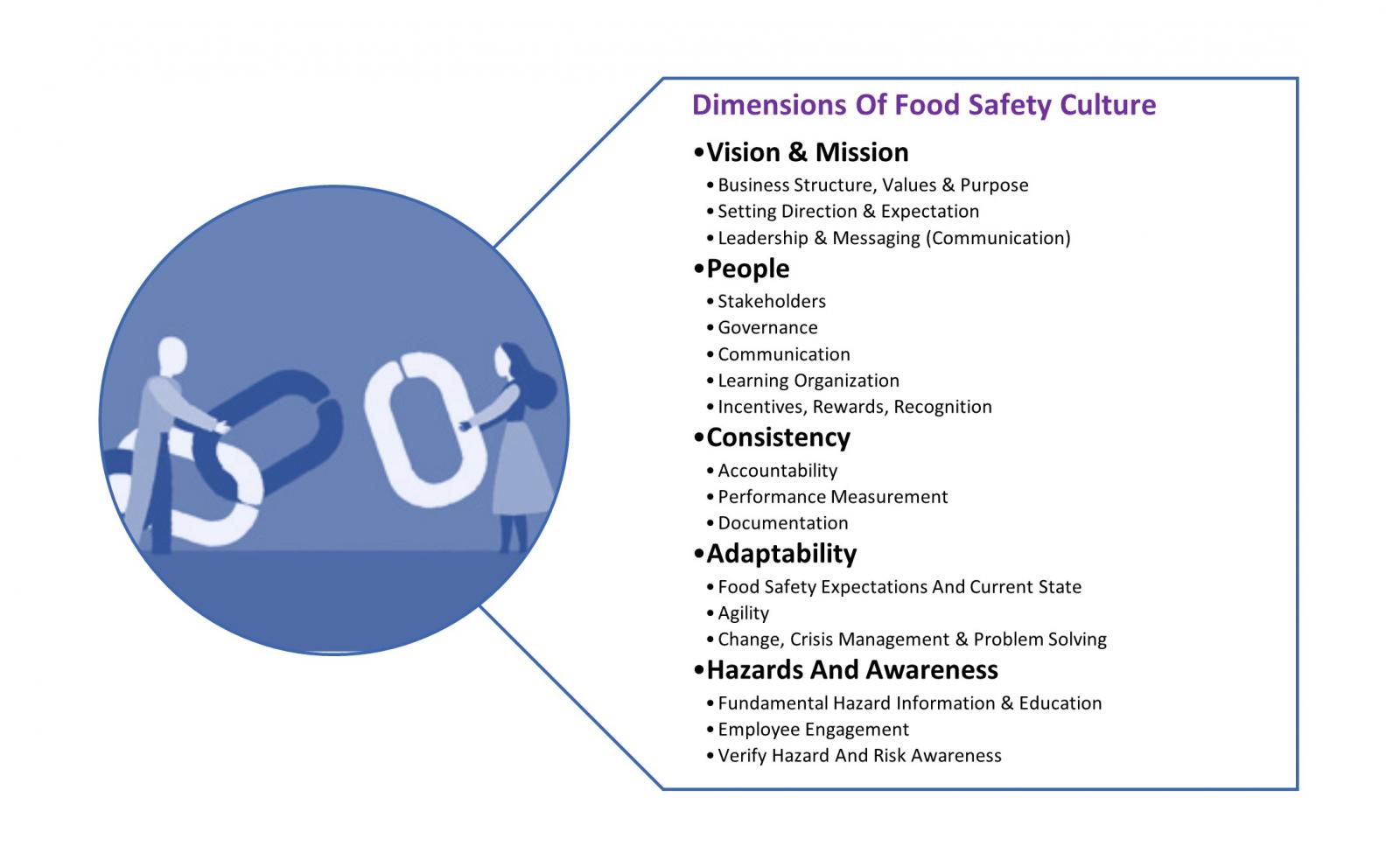
Image description source : GFSI-18
Vision and Mission (Leadership)
Organizational leadership sets the tone and direction for its food safety culture. The corporate vision and mission statements need not to mention food safety specifically, although its importance should be reflected in company communications. Direction-setting helps to establish a good food safety culture because it requires a clear vision, shared and embedded throughout the organization. Investment alignment ensures that the organization is properly resourced for food safety initiatives. A food safety policy statement places its requirements in alignment with the company’s strategic approach. It is essential to utilize effective communication regarding food safety across the entire organization, consumers and with the key stakeholders. The credibility of an organization’s food safety communication ultimately is dependent upon the value the organization places on food safety.
People
People are the critical component of a food safety culture. Employee’s attitude, behavior and activities, from processes on the farm to serving customers, contribute to the safety of food and potentially decrease or increase the risk of foodborne illness/incidents. It is important to establish a formal food safety structure with clearly defined individual roles and responsibilities. Major elements of this dimension include everything from educating employees and reinforcing good behavior to creating proper governance and monitoring/measuring system. The extent to which people are empowered to promote food safety will impact their organization’s ability to adapt, improve and sustain its food safety culture. Good communication ensures that the established policies/rules/regulations regarding food safety is understood by all within the organization. All leaders must “walk the talk,” and remain consistent in their communication to ensure that there is the clear understanding that food safety is a journey of continuous improvement.
Consistency
Consistency in food safety culture refers to ensuring the alignment of food safety priorities, with people, products, technology, resources, and processes, to effectively apply a food safety program and support its culture. Such consistency occurs in a variety of related decisions, actions and behaviors including accountability and compliance, performance measurement and documentation and conformity to sets of standards committed to conform. Other essential processes where consistency is crucial include various strategic points such as direction-setting in alignment with risks, investment alignment and coherent food safety communications.
Adaptability
Adaptability refers to the organization’s ability to adjust to changing influences and conditions. These changes may be anticipated or could take the form of an event, such as a situation of product recall or customer issue/customer complains. In any food enterprise with a strong food safety culture, its adaptability is reflected in its skill in anticipating, preparing for, responding, and adapting to change. Strong and committed leadership plays a significant role in how well a business enterprise adapts to change and responds to food safety crisis.
Hazard And Risk Awareness
This dimension of identifying, providing awareness and managing hazards and risks differentiates food safety culture from the broader organizational culture. Recognizing actual and potential hazards and risks at all levels and functions reflects a key element to building and sustaining a food safety culture. Basic scientific and technical information regarding potential and occurred food safety hazards and risks should be accessible and understandable to everyone. As a company, it is important to keep tab on the latest industry intelligence including market food safety incidents, changes to food safety legislation, significant new technology and analytical advances in food safety. This will widen awareness and understanding of potential risks and hazards. Understanding hazards at all organizational levels and functions is essential to establishing an effective food safety system thus creating a better food safety culture. This can be accomplished through ongoing education/trainings, the use of monitoring and metrics system, rewards, disciplinary actions and performance recognition, and reinforcing the importance of recognizing and controlling food safety hazards and issues.
For businesses like ours that work with businesses pursuing a third-party food safety certification audit , after several years of assisting and educating people about the food safety implementation and audit process, we have noticed that you can recognize early on whether a company’s pursuit is focused more on obtaining the necessary certificate or in ensuring that their products are safe. Most food industries fall somewhere in the middle of the spectrum, balancing the desire for food safety with legitimate concerns about profitability. It is not difficult for a Food safety Auditor, to identify whether a facility sees a food safety audit as another bureaucratic or organizational hurdle or an opportunity for growth. This kind of attitude often acts as an indicator of how the company will perform on their food safety audit. Food businesses that prioritize food safety and continuous improvement are likely to have better audit outcomes.
For anyone; it is not difficult to assess the Food Safety Culture of any food businesses; as Food safety culture refers to the specific culture of a businesses that determine what is happening when no one is watching. If you want to gauge a food businesses’ Food Safety Culture, try asking yourself how the business typically responds to arising food safety concerns. Does their staff take potential problem seriously, as if its importance is obvious? Or do they view food safety practices as just one more hurdle they need to jump through to stay in business? Many food safety consulting firm usually received their response to simply asked similar question as, “How much is this going to cost?” But in reality, no food businesses can afford not to develop a healthy Food Safety Culture. A strong culture of food safety helps their food businesses; both to prevent and identify deviations within in their processes that impact the safety, quality, economics and legality of their products and businesses.
It is important to remember that creating this type of food safety culture is only truly effective when it is backed up with clearly observable actions. Are employees provided with an effective way to share safety concerns confidently with management anonymously? Do they see and inform maintenance and repair activities being addressed promptly? Are they penalized for doing things wrong or resulting in breakdown of their food safety conformance in anyway? Are they addressing costumer complains adequately? and many more.
Creating, maintaining and updating a Food Safety Culture is a never-ending process of continuous improvement, but commitment to this area yields greater benefits for the bottom line, for employee satisfaction, for your brand image and more importantly for the families who consume your products. You can’t afford to neglect it.
World Food Safety Day 2021
Every year on June 7 , World Food Safety Day is celebrated. This year, the theme is 'Safe food today for a healthy tomorrow'. With this, the World Health Organization (WHO) highlights that the production and consumption of safe food have immediate and long-term benefits for people, the planet, and the economy.
If you are considering to elliviate your Food Safety Culture ; you are at right place. GBQC will assist you create , establish , document and update your Food Businesses' FOOD SAFETY CULTURE through various services of consultancy, trainings and auditing . Click on the links below for more information.
Food Safety Hygiene Design Consultancy
Written by : M. Chhetri ( Food Safety Consultant and Auditor); 7 June, 2021 Special Cover for World Food safety Day 2021
© gbquality.com.np 2021. All Rights Reserved.
Design & Developed by Dradtech Technology